
Custom socks are a powerful medium for brand identity, team apparel, and retail collections. When developing a line, your first critical manufacturing decision is choosing between dye-sublimation printing and jacquard knit-in construction.
Neither method is universally superior-sublimation enables photo-realistic, full-color artwork, while jacquard knitting builds classic designs directly into the yarn structure. The optimal choice depends on your design complexity, target fiber composition, order volume, and retail positioning.
Sublimation vs. Knit-In: What Is the Difference?
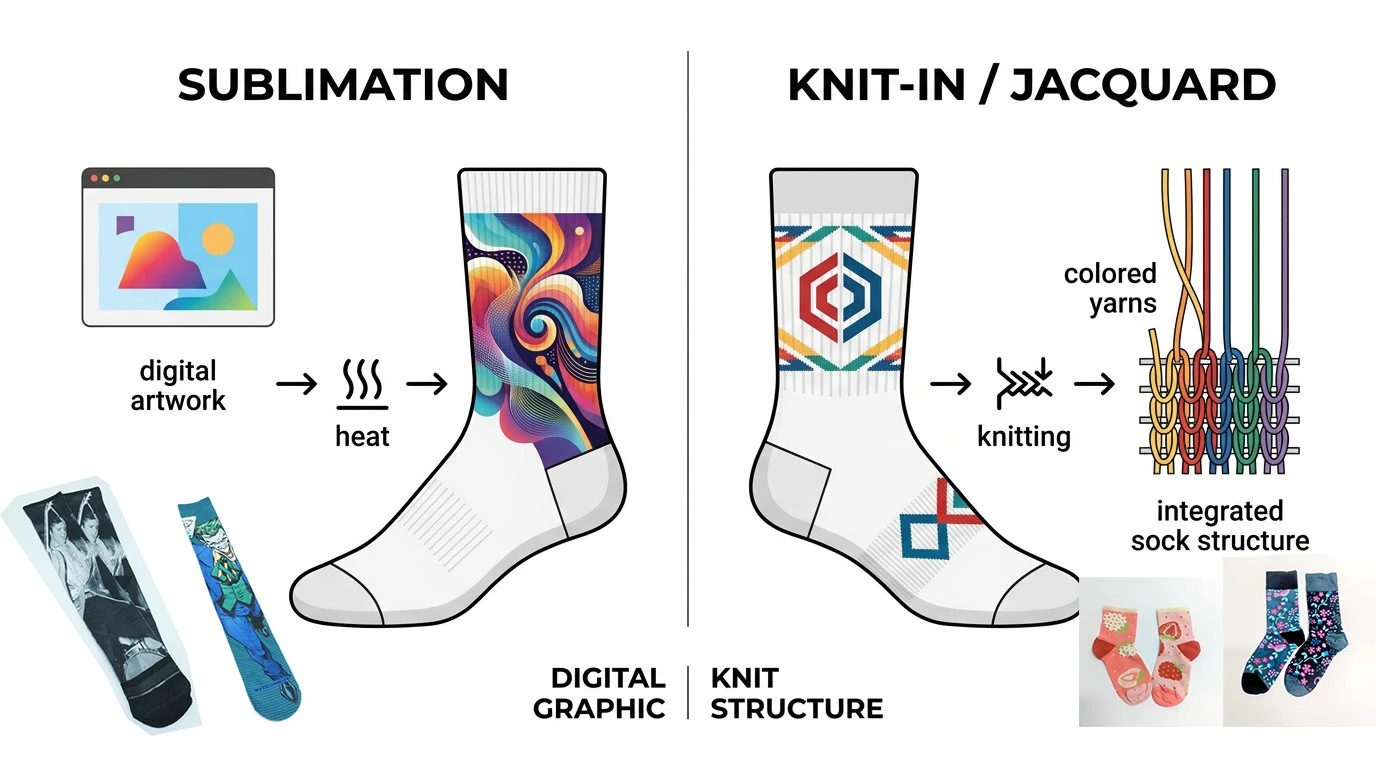
The fundamental difference lies in how the design is integrated into the sock structure.
Dye-Sublimation Printing uses high heat to transfer disperse dyes deep into synthetic fibers, primarily polyester. Because the artwork is digitally rendered, this process excels at reproducing photo-realistic graphics, complex multi-color gradients, and fine illustrations.
Jacquard Knit-In Construction builds the design directly during the knitting process. Colored yarns are selectively fed and interlaced into the sock's structural grid to form logos, text, geometric patterns, and stripes. The artwork becomes an integral part of the textile itself, rather than a surface layer.
Simply put: Sublimation delivers unlimited digital graphic detail, while Jacquard knitting seamlessly integrates the design into the physical fabric structure.
Sublimation Custom Socks: Advantages and Limitations
When Sublimation Works Best
Sublimation's primary advantage is its ability to reproduce complex, digitally controlled graphics without the color limits of traditional yarn.
It is ideal for:
* Photographic images and full-color illustrations
* Gradients and smooth tonal transitions
* Intricate multi-color patterns and edge-to-edge artwork
For fashion collections, promotional merchandise, or artwork-driven designs, sublimation offers maximum creative flexibility by bypassing the color constraints of jacquard yarn selection.
What Should Brands Consider?
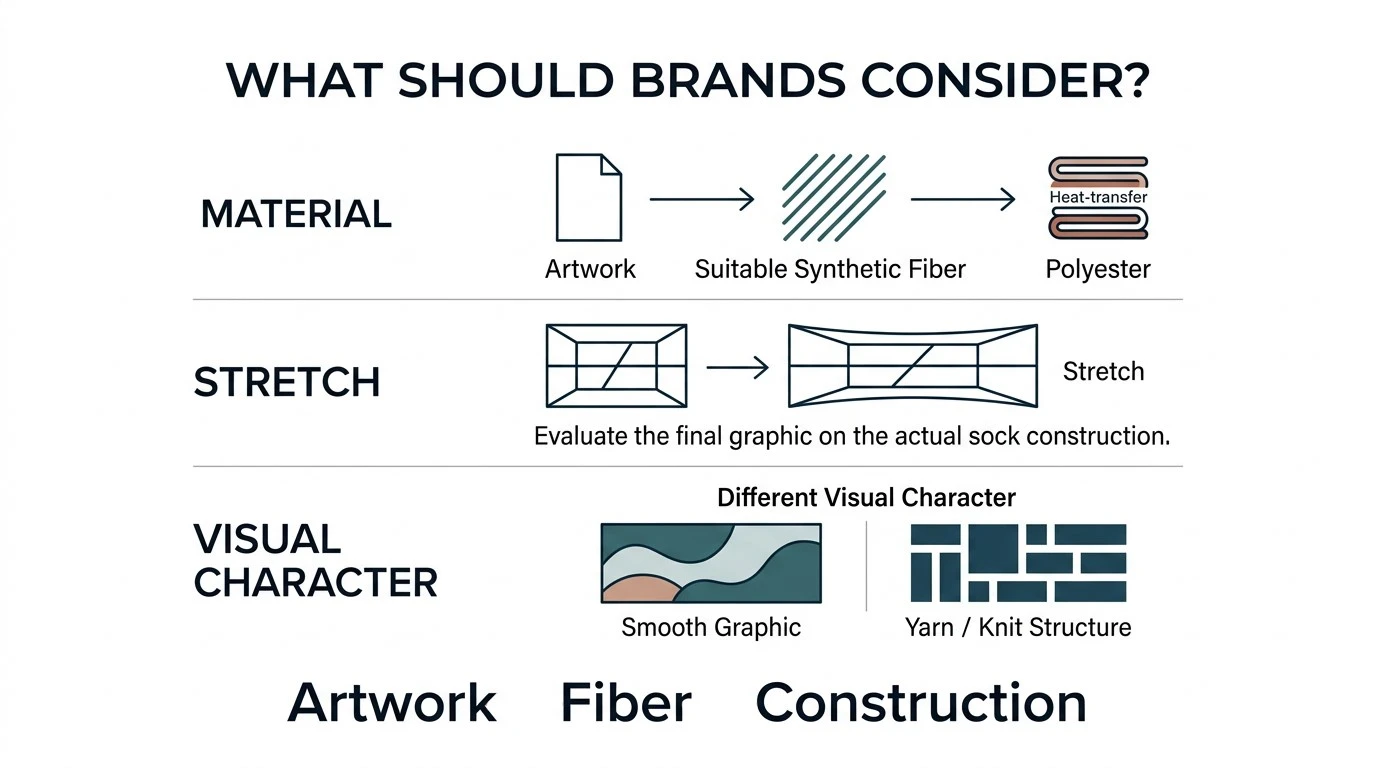
Sublimation is not independent of material selection.
The process relies on suitable synthetic fibers, with polyester being particularly important for achieving the intended dye transfer and color result. This means brands considering sublimation should evaluate the artwork and fiber composition together rather than choosing the printing method first and the material afterward.
Stretch is another consideration. Socks are designed to stretch during wear, so the final appearance of a detailed printed design needs to be evaluated in relation to the sock's construction, fabric and degree of stretch.
The visual character is also different from a knit-in sock. Sublimation creates a smooth, graphic-driven appearance, while knit-in designs derive their visual identity from yarn and knitted structure.

Knit-In Custom Socks: Advantages and Limitations
When Knit-In Works Well
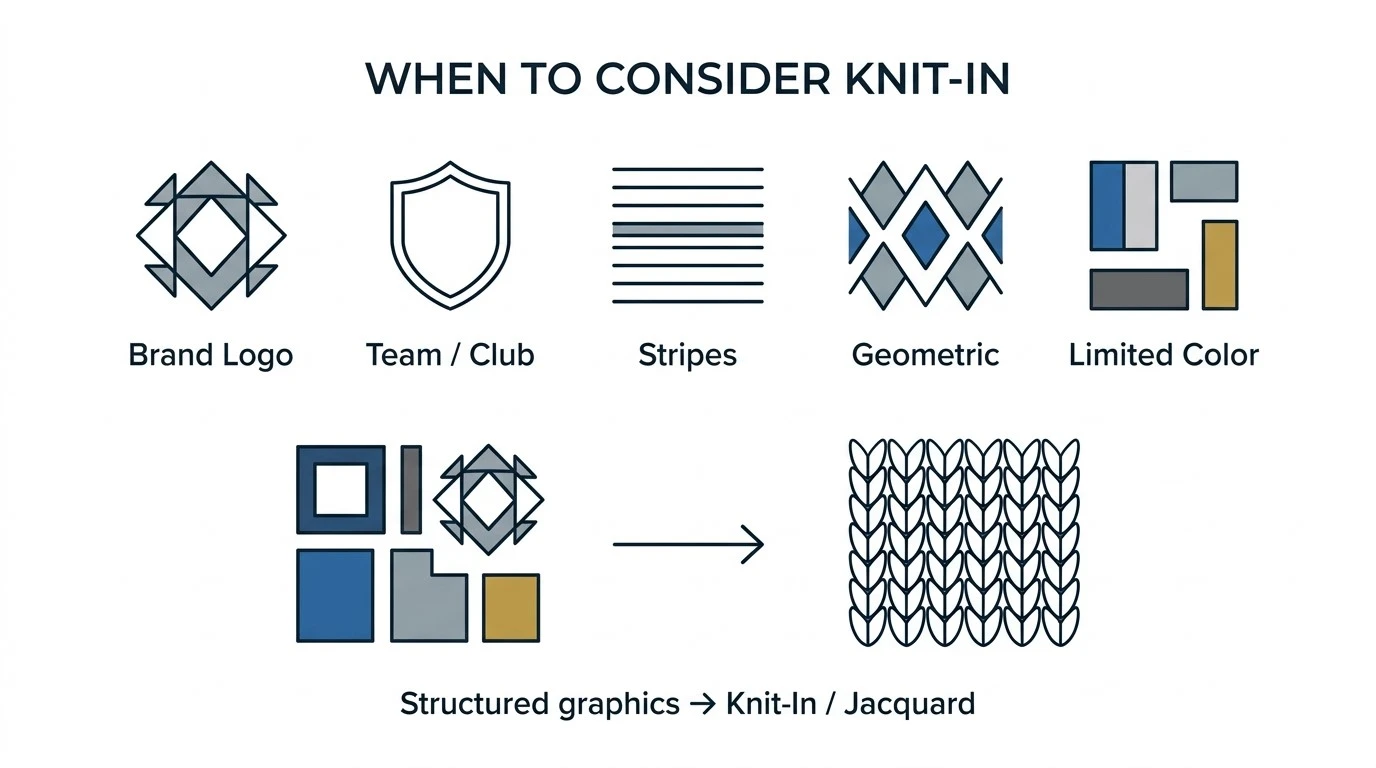
Jacquard knit-in construction is most effective for clear, structured designs where graphics are built directly into the sock fabric.
Typical applications include:
* Brand and team logos
* Text and typography
* Stripes, geometric patterns, and repeating motifs
* Simple, solid-color illustrations
Because the design is generated using colored yarns during the knitting process, it creates an authentic, traditional textile look. This makes knit-in construction the standard choice for branded retail collections, sports teamwear, and athletic socks where brand identity needs to be bold, clean, and durable.
What Should Brands Consider?
The same structural advantage creates a design limitation.
Because the artwork has to be translated into a knitted structure, highly detailed photographs, smooth gradients, and very fine visual transitions are difficult to reproduce with the same fidelity as digital sublimation. Small text and fine lines may also need to be simplified during artwork preparation.
The practical result is simple:
Knit-in is strongest when the design is bold, structured, and easy to translate into yarn-based graphics.
It is not a matter of the technology being less capable overall. It is a matter of using the technology for the type of design it is structurally suited to produce.
Which Method Is Better for Your Product?
A practical way to make the decision is to start with the design, rather than the production method.
Consider Sublimation If Your Design Requires:
·Complex illustrations
·Full-color graphics
·Gradients
·Photographic imagery
·Extensive visual coverage
·A high degree of digital design flexibility
These characteristics make sublimation particularly relevant to artwork-driven fashion socks, promotional products, event merchandise, and other designs where visual complexity is central to the product.
Consider Knit-In If Your Design Requires:
A prominent brand logo
Team or club identity
Stripes
Geometric patterns
Structured, limited-color graphics
A traditionalonal knitted appearance
This makes knit-in construction well suited to branded retail products, sports teams, clubs, corporate programs and teamwear.
A useful rule is:
If the artwork is the main selling point, sublimation may offer greater creative freedom. If the brand identity needs to be integrated into the textile itself, knit-in may be the better fit.
Custom Sock Manufacturing: Dye-Sublimation vs. Jacquard Knit-In
Choosing between dye-sublimation printing and jacquard knit-in construction isn't just an aesthetic choice-it dictates your yarn selection, product performance, and overall OEM production costs.
Key Feature Comparisons for B2B Procurement
* Design & Artwork Suitability
Dye-Sublimation is ideal for photorealistic art, full-color gradients, and highly detailed graphics that cannot be knitted with yarn. In contrast, Jacquard Knit-In Construction excels at bold logos, geometric patterns, clean typography, and traditional sports team designs.
* Fiber & Material Composition
Sublimation printing requires a high synthetic fiber base, specifically 100% polyester or polyester blends, to effectively bond disperse dyes. Conversely, Jacquard socks offer superior material flexibility, allowing custom yarn blends including combed cotton, bamboo, merino wool, nylon, and spandex.
* Durability & Structural Performance
Properly sublimated designs resist peeling and cracking because the dye infuses into the fiber, though white elastic show-through can occur when stretched. Jacquard knit-in designs provide exceptional long-term structural durability because the color pattern is built directly into the sock fabric during the knitting process.
* Tactile Feel & Breathability
Sublimated socks feature a smooth surface print but offer lower natural breathability on thicker socks. Jacquard socks deliver a classic knitted hand-feel, traditional surface texture, and superior softness and breathability.
* Production Cost Drivers
Sublimation costs are driven by blank sock stock and printing setups, making it efficient for complex graphics on smaller runs. Jacquard production cost is determined by yarn dyeing, machine needle counts, and graphic programming-delivering much better unit economics for high-volume OEM/ODM orders.
Strategic B2B Decision Factors
Fiber Performance vs. Visual Detail
If your brand positioning prioritizes rich graphic details or photographic art, sublimation on polyester is the correct technical path. However, if your retail target demands moisture-wicking natural fibers, organic cotton, or heavy cushion soles, jacquard knitting is mandatory.
True Cost & Order Minimums (MOQs)
Evaluating only unit prices can be misleading. While sublimation offers lower setup costs for complex multi-color designs, bulk production orders typically achieve superior unit cost efficiency on automated jacquard knitting machinery.
What to Provide Your Sock Manufacturer Before Sampling
To speed up pre-production technical reviews and ensure accurate quotations, submit the following specifications in your initial product brief:
* Vector Artwork & Color Specifications (AI, EPS, or PDF format with exact Pantone codes)
* Target Material Composition (e.g., 80% Combed Cotton / 15% Nylon / 5% Spandex)
* Sizing & Style Specs (Crew, Ankle, No-Show, Cushion Sole)
* Estimated Order Quantity (MOQ per design/size)
* Custom Packaging Requirements (Header cards, polybags, or custom boxes)