
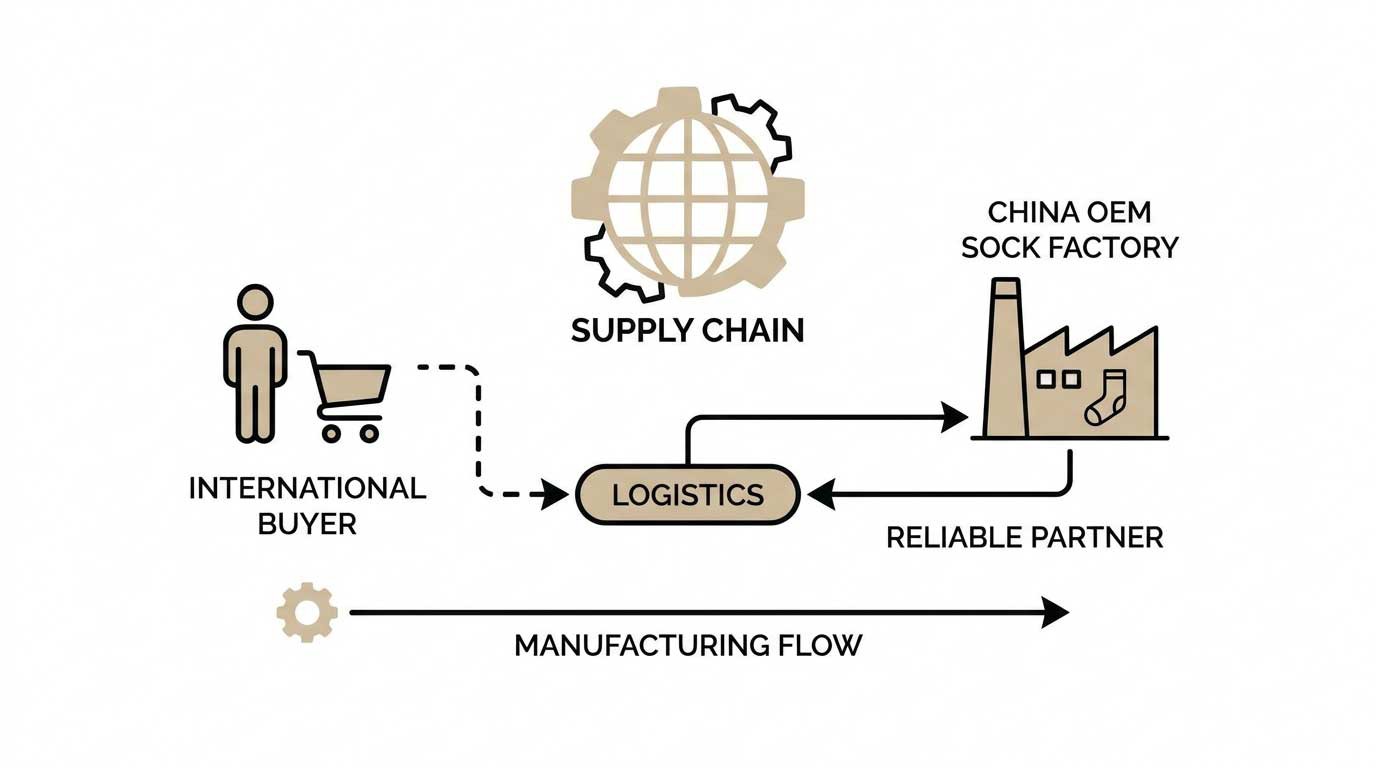
Launching or scaling a custom socks private label remains a highly lucrative venture in 2026. Whether you are managing an established e-commerce brand, sourcing corporate gifts, or stocking high-performance athletic apparel, securing a reliable OEM/ODM socks manufacturer in China is the single most critical factor for your business continuity.
However, the global textile supply chain has shifted. In 2026, international buyers face harsher import regulations, fluctuating freight markets, and intense competition demanding ultra-fast market responses. Navigating thousands of online suppliers to find a genuine source factory-rather than a middleman adding hidden margins-requires a strategic approach.
As a deeply rooted, export-oriented custom socks factory in China with decades of international manufacturing experience, we are pulling back the curtain. Here are the top 5 procurement secrets to identifying a truly reliable manufacturing partner.
Secret 1: Verify Automated Capacity and Machine Genealogy over "Factory Videos"
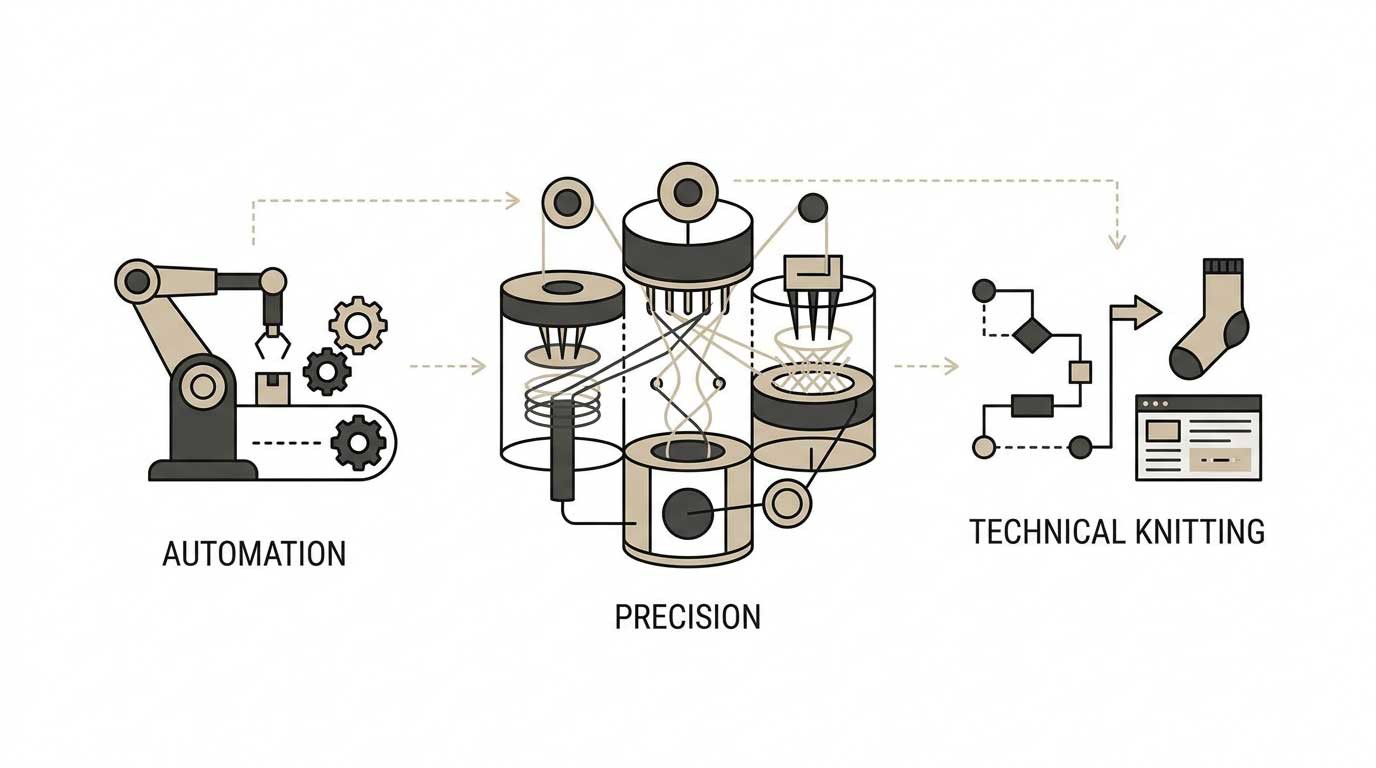
In the past, buyers were told to ask for simple factory video tours. In 2026, savvy trading companies can easily stage video walkthroughs of rented facilities. To find a true source manufacturer, you must audit their production technology and machinery infrastructure.
- Audit the Machine Fleet: True Tier-1 manufacturers do not hide behind generic machinery. Ask for their equipment manifest. Top-tier factories utilize imported, fully automated Italian Lonati circular knitting machines or premium digital single/double cylinder systems. These machines guarantee Intelli-knit (knitting-turning-linking integrated) precision, which directly dictates fabric weight consistency and structural durability.
- Technical Fluency in Complex Knits: A genuine source factory can immediately provide technical consultation on complex fabrications-such as multi-density terry cushioning for athletic grip socks, medical-grade compression socks, or high-needle-count (168N / 200N) combed cotton dress socks. A trading company will typically delay communication, stating they need to "check with the technician."
Secret 2: Demand Absolute ESG Compliance and Material Traceability
In 2026, compliance is not a preference; it is a legal requirement. With stringent global customs regulations targeting forced labor and non-transparent supply chains, a reliable Chinese manufacturer must serve as your compliance shield.
- GRS Certification & Transaction Certificates (TC): If your brand promotes sustainability-such as recycled polyester (rPET), organic cotton, or specialized Merino wool blends-the factory must provide valid Global Recycled Standard (GRS) certifications. More importantly, they must be able to issue a Transaction Certificate (TC) for every bulk shipment to prove material traceability at your country's customs check.
- International Facility Audits: A reliable B2B export partner always holds active, up-to-date third-party audit reports. Before placing a deposit, request their BSCI, SEDEX (SMETA), WRAP, or OEKO-TEX Standard 100 credentials. If a supplier makes excuses regarding audit visibility, they cannot support mainstream retail distribution.

Secret 3: Evaluate "3D Digital Sampling" and Agile MOQ Flexibility
The biggest risk for apparel brands in 2026 is deadstock. Reliable factories have evolved their R&D departments to accommodate flexible, lower-risk inventory models through Quick Response (QR) manufacturing.
- 3D Digital Prototyping: Leading manufacturers have transitioned from slow, costly physical sampling to advanced 3D digital sampling. Using specialized software (like Shima Seiki SDS-ONE APEX), a top factory can generate photorealistic 3D sock prototypes within 24 to 48 hours. This accelerates your time-to-market and cuts down international courier fees for physical revisions.
- Flexible MOQs Backed by Yarn Inventory: While traditional factories demand 3,000 pairs per style/color, agile OEM partners maintain a vast raw material inventory of pre-dyed combed cotton, nylon, and spandex. This allows them to offer flexible Minimum Order Quantities (e.g., 500 to 1,000 pairs per color/size) for initial market testing, followed by rapid bulk replenishment.

Secret 4: Look Beyond "Hand-Linked Toes" to Total Inline Quality Control
"Hand-linked seamless toes" used to be the gold standard for premium socks. While critical for high-end dress socks and performance running socks, relying purely on manual labor introduces human error in mass production. 2026 quality assurance requires systemic automation.
- Clarify the Seam Technology: Ensure your supplier accurately differentiates between traditional Rosso linking (which leaves a palpable ridge), automated machine imitation hand-linking, and true hand-linked appearance generated by integrated knitting-linking machinery.
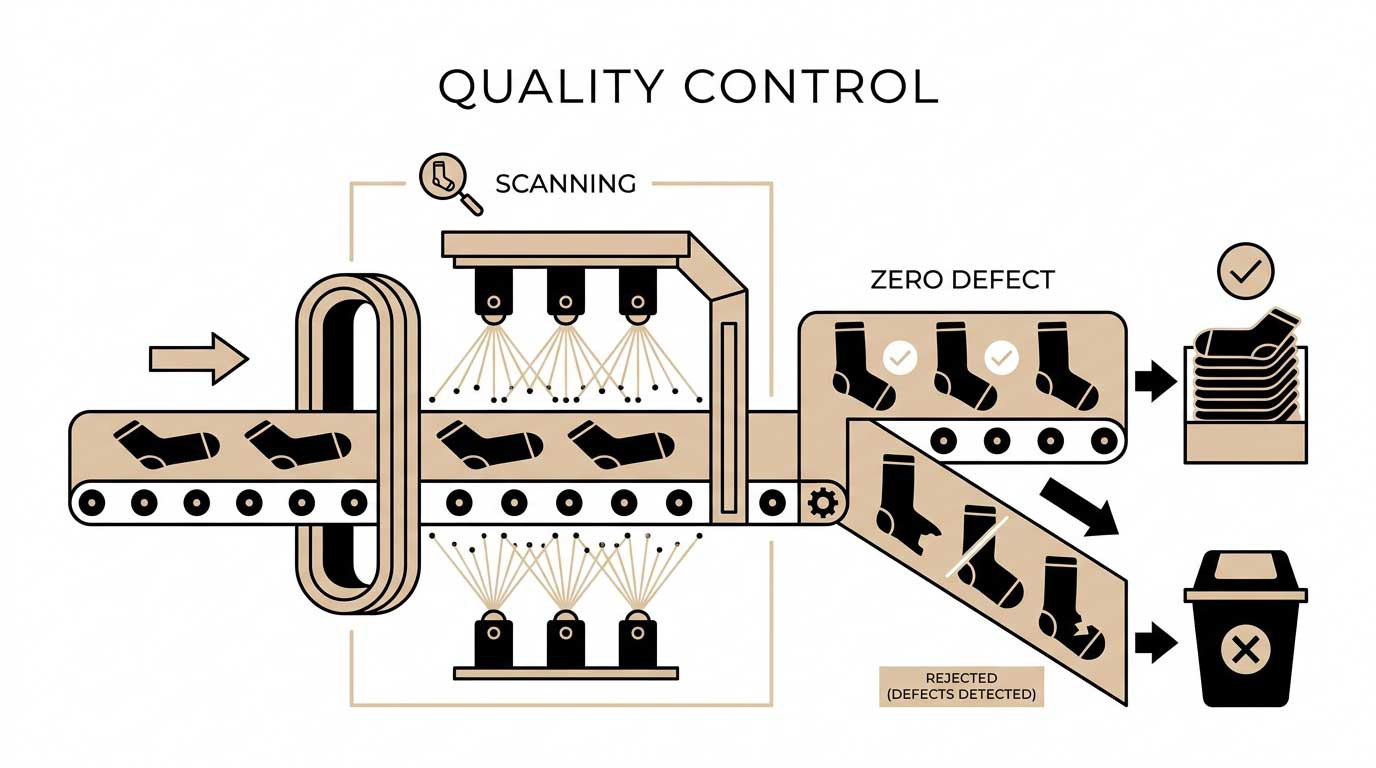
- Inline Defect Detection and Needle-Scanners: Ask the supplier about their inline quality control protocols. Do they use vision-sensor camera systems during knitting to catch dropped stitches instantly? Crucially, do they route 100% of finished bulk goods through an automated Metal Detector / Needle-Scanner before packaging? For brands selling to major supermarket chains or infant wear categories, broken needle prevention is a zero-tolerance compliance line.
Secret 5: Assess Global Logistics Competence and DDP Risk Mitigation
A premium manufacturing partner does not just drop cargo at the port of FOB Shanghai or Ningbo. They must understand international trade barriers, anti-dumping duties, and turnkey freight fulfillment.
- Tariff and Geo-Sourcing Mitigation: True industrial leaders often feature diversified supply chain footprints. If your brand is heavily impacted by specific regional tariffs, ask if the manufacturer has cross-border manufacturing capabilities (e.g., raw material processing in China with final assembly or secondary facilities in Southeast Asia) to optimize import duties legally.
- Turnkey DDP (Delivered Duty Paid) Expertise: Sourcing managers shouldn't waste energy dealing with complex customs brokerage. A highly reliable export manufacturer has established partnerships with global freight forwarders to offer transparent DDP shipping solutions. This means they handle export customs clearance, international ocean/air freight, destination port import clearance, and local duties-delivering goods directly to your 3PL warehouse with zero hidden fees.
Conclusion: Upgrade Your Supply Chain for 2026 and Beyond
In 2026, the success of an apparel brand relies entirely on the resilience of its backend infrastructure. Finding a reliable custom socks manufacturer in China requires looking past low-ball pricing and evaluating digital capacity, strict ESG compliance, and flexible logistics.
Ready to upgrade your custom socks supply chain?
As an accredited, technologically advanced OEM/ODM sock manufacturer, we provide international brands with certified sustainable materials, cutting-edge automated knitting, and completely seamless export compliance. Contact our sourcing engineering team today to request a free 3D digital design rendering, exact factory direct quotes, or copies of our latest GRS and BSCI audit reports. Let's build a reliable, high-margin future for your brand together.