
When it comes to custom headwear, the decoration method often matters more than the hat style itself. Whether a brand appears premium and professional, whether a logo stays clear after repeated wear, and whether production costs remain controllable all depend largely on one key decision: embroidery or printing.
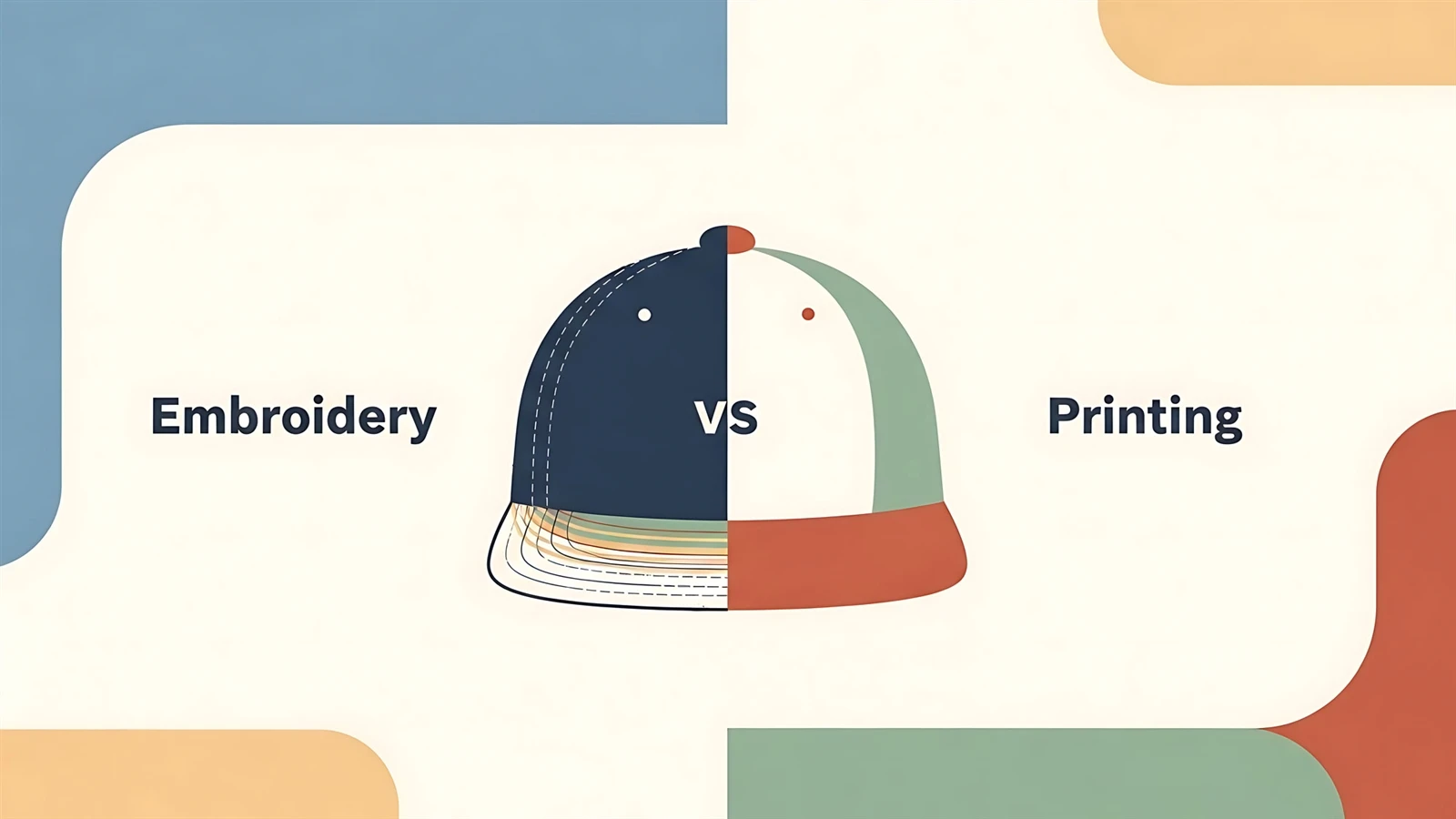
Both techniques are widely used in modern hat manufacturing, and each serves different design goals, budgets, and use cases. This article provides a practical, experience-based comparison of embroidery and printing, helping brands make informed decisions based on material compatibility, durability, cost structure, and real-world applications.
What Is Embroidery - and Why Is It So Popular?
Embroidery is a decoration technique that stitches colored threads directly onto the fabric surface using embroidery machines. Because embroidery thread has physical thickness, the finished design naturally appears textured and dimensional, even when the artwork itself is simple.
Key Characteristics of Embroidery
Dimensional and premium appearance
Embroidery creates a raised surface with rich color and tactile depth, which is often associated with higher perceived value.
Excellent durability
Properly executed embroidery holds up well against repeated washing, friction, and sunlight exposure, with minimal risk of fading or peeling.
Ideal for logos and brand marks
Widely used on baseball caps, trucker caps, bucket hats, and structured headwear where brand identity is a priority.
Common Types of Embroidery Used on Hats
Flat embroidery
The most common method, offering clean lines and sharp details.
3D puff embroidery
Foam is placed beneath the stitches to create raised lettering or shapes, often used for bold logos.
Appliqué embroidery
Fabric patches are stitched onto the hat, suitable for larger letters or graphic elements.
Limitations of Embroidery
Fine gradients and photographic details cannot be reproduced.
Cost increases with stitch count and number of thread colors.
Large embroidered areas add weight and raise production costs.

What Is Printing - and When Does It Make More Sense?
Printing applies designs directly onto the hat surface using methods such as screen printing, heat transfer, or DTF (Direct to Film). Compared to embroidery, printing excels at handling complex visuals and multi-color artwork.
Common Printing Methods for Hats
Screen printing
Cost-effective for large quantities with solid colors.
Heat transfer
Suitable for multi-color graphics, gradients, and photographic images.
DTF (Direct to Film)
Offers vibrant color reproduction and works across various fabric types.
Printed patches combined with stitching
A hybrid approach that balances detail and durability.
Advantages of Printing
- Handles complex artwork, gradients, and photo-style designs.
- Generally lower cost for large or full-coverage graphics.
- Flexible for small-batch or frequently changing designs.
Limitations of Printing
- Durability varies by method and usage conditions.
- Less effective on uneven, highly textured, or stretchy surfaces.
- Flat feel without the tactile depth of embroidery.

Embroidery vs. Printing: A Side-by-Side Comparison
1. Visual Appearance
- Embroidery: Textured, dimensional, and premium.
- Printing: Flat but highly detailed and colorful.
2. Durability
- Embroidery: Highly resistant to wear and fading.
- Printing: May wear over time, depending on technique and fabric.
3. Cost Structure
- Embroidery: Priced by stitch count; larger designs cost more.
- Printing: Often priced by area or color; economical for complex designs.
4. Design Compatibility
- Embroidery: Logos, lettering, simple shapes.
- Printing: Illustrations, gradients, photos.
5. Production Scale
- Embroidery: Best for medium to large runs with consistent designs.
- Printing: Ideal for small batches and frequent artwork changes.
6. Hat Type Compatibility
- Baseball caps: embroidery preferred
- Trucker caps: embroidery or screen printing
- Bucket hats: printing offers more flexibility
- Performance caps: lightweight printing methods perform better

How to Choose Based on Your Brand Needs
If You Want to Elevate Brand Image
Choose embroidery.
It enhances perceived quality and professionalism, making it ideal for brand logos, corporate hats, team headwear, and premium merchandise.
If Your Design Is Color-Heavy or Photo-Based
Choose printing.
Screen printing, heat transfer, and DTF handle high-saturation visuals with ease.
If Budget and Large Quantities Are a Priority
Printing is generally more cost-efficient, especially for large graphic areas.
If You Are Producing Corporate or Gift Hats
Embroidery is strongly recommended for long-term durability and refined appearance.
Cost Estimation Guidelines
Embroidery Cost Factors
- Stitch count is the primary driver of cost.
- 3D puff embroidery increases material and labor requirements.
- More thread colors increase setup complexity; six colors or fewer is commonly recommended.
Printing Cost Factors
- Screen printing is cost-efficient at higher volumes.
- Heat transfer suits small batches and multi-color designs.
- DTF offers high flexibility across different materials.
Tips for Budget Optimization
- Simplify embroidery designs into clean lines or lettering.
- Convert complex graphics into printed designs.
- Use printing for large-area artwork to control costs.

Frequently Asked Questions
Can embroidery create gradients?
+
-
No. Gradients require printing techniques.
Does printing fade easily?
+
-
Durability depends on the method. DTF and modern heat transfers typically outperform traditional prints.
Is 3D embroidery suitable for all hats?
+
-
No. It works best on structured fabrics and is not recommended for thin or unstructured caps.
Can embroidery be used for small orders?
+
-
Yes, though unit costs are usually higher than printing.
Will printing crack over time?
+
-
Screen printing may crack on elastic fabrics; DTF is generally more adaptable.
Final Thoughts
There is no universally "better" option between embroidery and printing. The right choice depends on your brand positioning, design complexity, budget, and intended use. Many successful headwear collections combine both methods across different product lines to balance aesthetics, performance, and cost.
Making informed decoration decisions is a key step toward building a consistent, scalable, and long-lasting headwear program.